
During the third quarter, the equity market became even narrower as market participants reacted to greater uncertainty. As we have seen over the past couple of years, rising Geopolitical and inflation concerns have led to increased market volatility. The ongoing conflicts in Ukraine and the Iran War have put upward pressure on energy prices, while interest rates recently increased across government maturities. With growing fears of stubborn inflation and higher interest rates, it’s not surprising that Mr. Market recently favored larger market cap equities.
During the quarter, the 30 largest US Stocks as a percent of the Total US Market Capitalization climbed to a new record at 50%, which is one-third higher than the average between 1989 and 2022 and 1000bps above the 2000-01 dot.com peak!
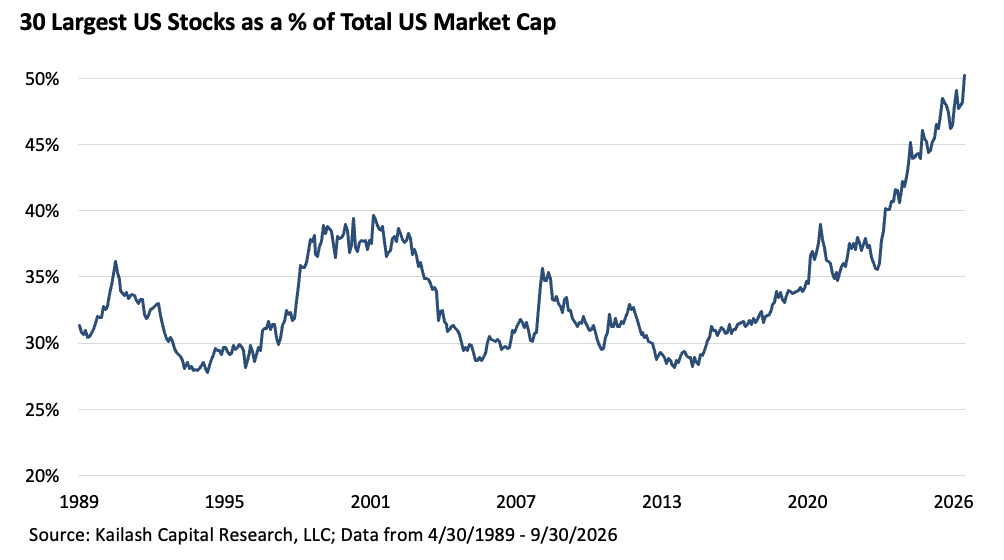
A closer look at the composition of the largest 30 stocks reveals ten of the top eleven are leading AI companies, whose weighting in the S&P 500 has doubled since 2023 to 41%, a level of concentration that was seen during prior market extremes (Nifty Fifty in the 1970s, Japan equities in the 1980s and TMT during the late 1990s). The 30 largest U.S. stocks price to sales multiple is now approaching 7x, nearly 40% higher than the 5x peak in 2000 and 2021!
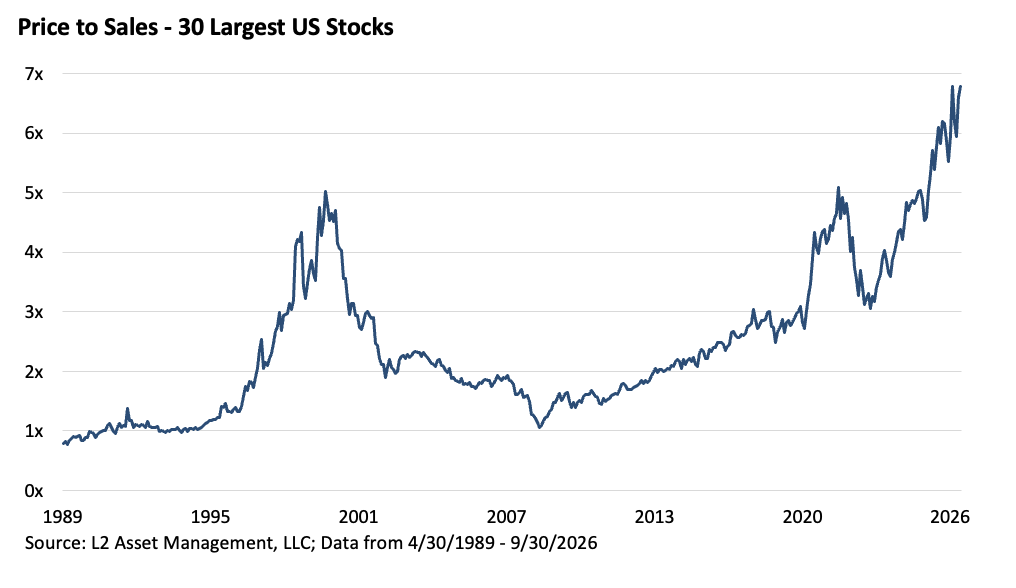
Here again, longer duration equities are fueling the valuation expansion as leading AI companies and technology stocks within the top 30 have an average price-to-sales over 15x. High valuations embed in today’s prices lofty market expectations well into the future. As a result, we believe the marketplace is overlooking the growing concentration risk of increasingly correlated large cap passive indexes. An investor who believes they are diversified using passive indexes are becoming increasing vulnerable to an unexpected future correction in crowded longer duration equities.
For the past couple of years, there has been an ongoing positive feedback loop that supported the massive AI capex build-out. AI-related companies have had an abundant amount of low-cost capital through ongoing Private Equity support, a favorable IPO market, circular financing relationships and debt markets that have demanded financing at a slight premium to the risk-free rate. However, recently we have started to see some cracks at the margin. The IPO market is starting to become less accommodating and recent AI debt market issuances have been met with falling prices and rising yields. Later phases of massive capital cycles have historically seen a greater focus on the potential risks and market excesses. Participants who fail to meet lofty market expectations and have over-levered balance sheets can quickly find themselves with growing refinancing fears. Time will tell whether investors begin to demand higher yields and more profitable business models. However, we see the potential for the market to eventually rotate from those who are spending significant amount of capital building AI capabilities to companies that may become beneficiaries from AI driven productivity.
While the growing market concentration in longer-duration equities is supporting the market near its all-time highs, we see a growing number of companies that are significantly off their highs for the year with depressed market prices generating attractive double-digit earnings and free cash flow yields. Current levels are still more than twice the current risk-free rate. During the third quarter, the underperformance of small caps versus large was the third worst (880bps) when looking back nearly 50 years. The 5 largest companies in the S&P 500 are at a new record, 6x the entire Russell 2000!
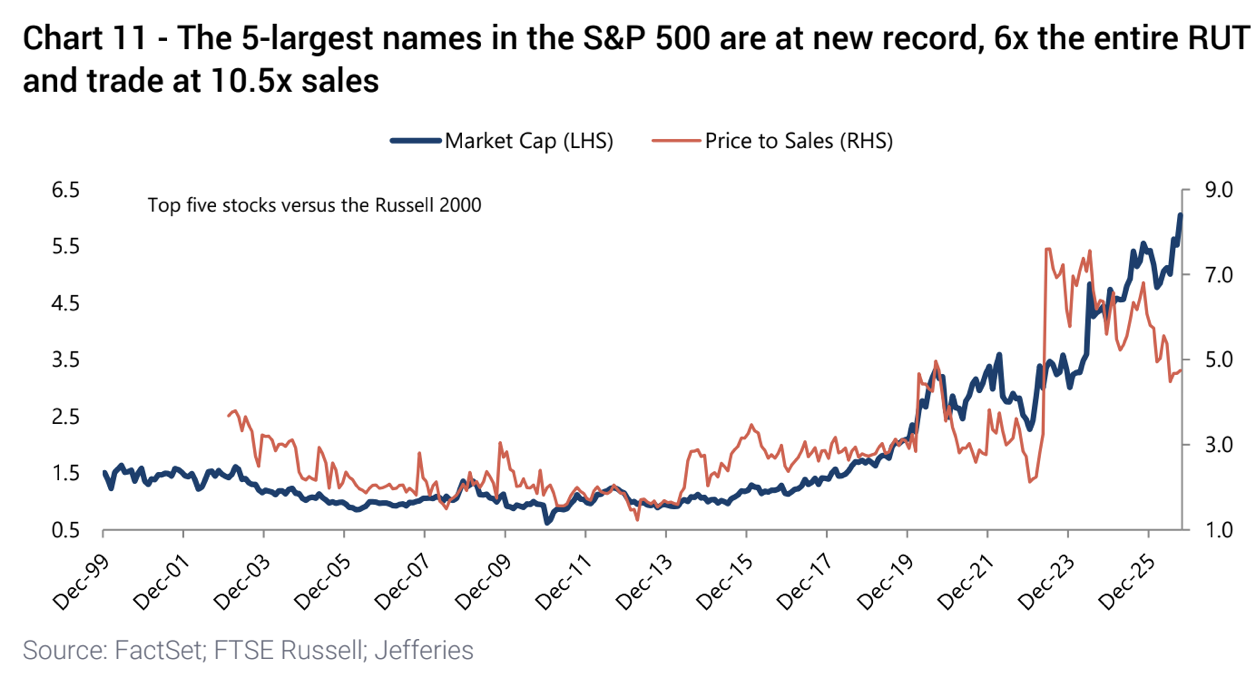
Their price to sales is nearly 5x higher than the small cap universe. We continue to see wide price to value dislocations within the smaller market cap universe embedding very low market expectations. Today a value investor can find more attractive reward/risk opportunities within this under followed universe.
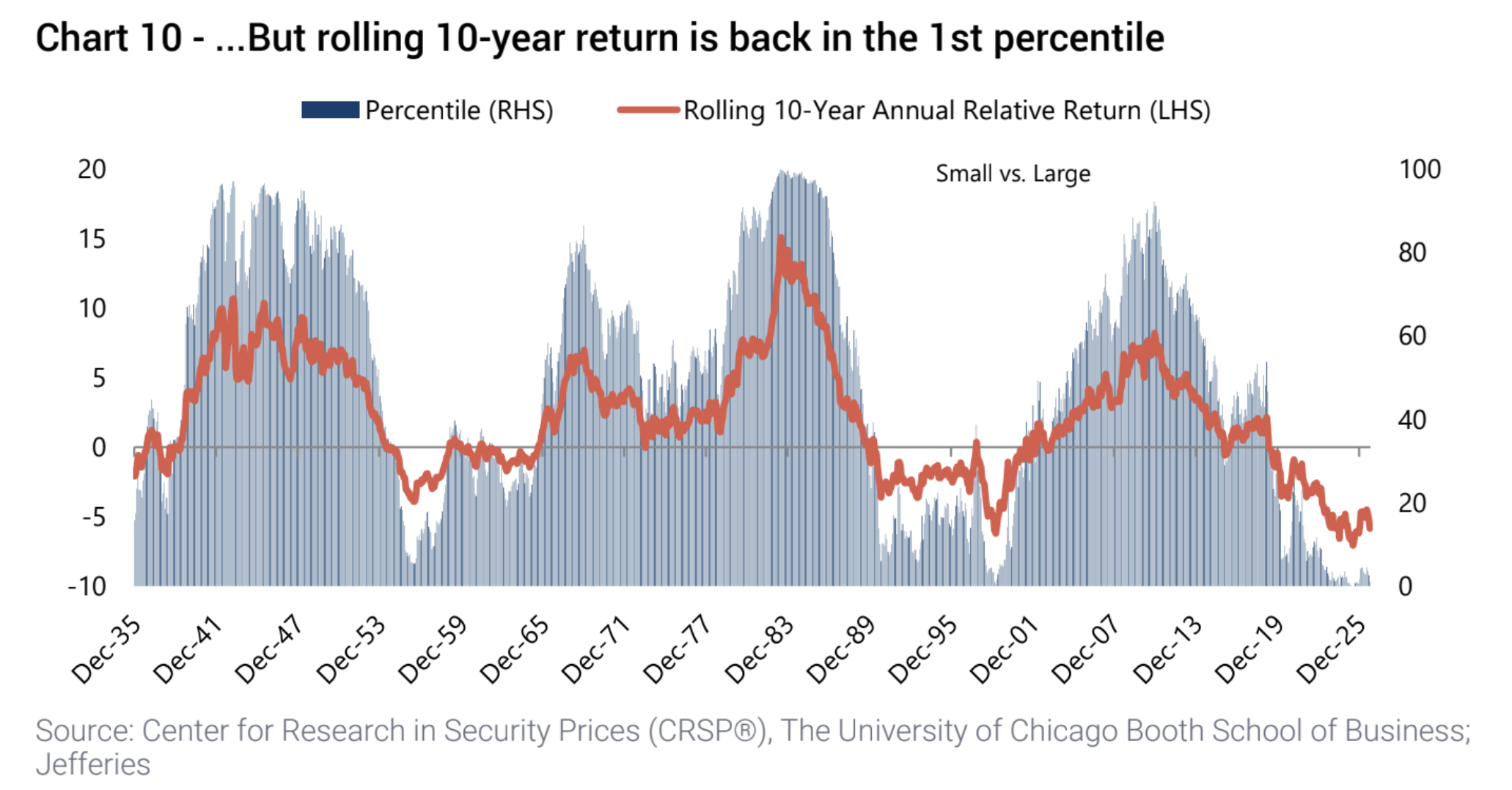
While market participants may cite the rise in interest rates for smaller company recent under performance, history suggests there is less impact on smaller companies than what is feared today. Strategas Research Partners recently looked at the average returns from the first rate hikes between 1975 and 2022, and the Russell 2000 outperformed the S&P 500 over the following 20 days, 65 days, 125 days and 250 days. In fact, smaller market caps not only outperformed but were positive over each of the time periods highlighted. Historical small cap versus large-cap market cycles have been long in duration, 10-14 years in length. The cycles have been driven by market concentration extremes, relative valuation, earnings growth and rolling 10-year returns. During the past quarter, small cap earnings growth outperformed larger companies. And, with economic growth remaining resilient and ongoing deregulation, we see a likelihood for this to continue over the coming quarters. We would also highlight the rolling 10-year performance between large and small caps is back at 1st percentile (100-year low)!
As recent fears subside, we expect the market to resume broadening as investors revisit attractively priced lower valuation securities. We believe the near-term market volatility is providing another great opportunity to selectively take advantage of low market expectations!
Deep Value Select Strategy Highlights
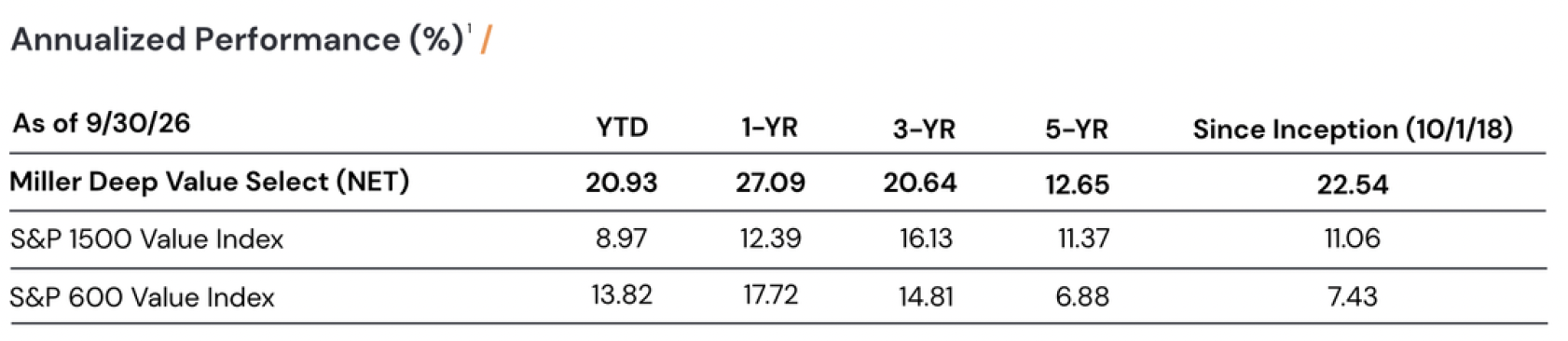
During the quarter, the Deep Value Select strategy net returns were +5.45%, ahead of the S&P 1500 Value Index +.31% and the S&P 600 Value Index at -5.88%. Year to date, Deep Value Select Strategy net returns were +20.93%, nicely ahead of the S&P 1500 Value Index at +8.97% and the S&P 600 Value Index at +13.82%.
During the quarter, the two largest positive contributors were Fossil Group (FOSL), whose share price increased 58.7%, and Gray Media (GTN), whose share price increased 13.4%. Fossil Group’s new management continues to have success in executing their transformation plan. New product introductions have reversed a decade plus decline for their traditional watch business. As the company rolls out additional new products and anniversaries store closings we expect overall company revenue to return to growth. While a weakening consumer is an ongoing risk, Fossil’s new product pipeline has positioned the company for ongoing market share gains and incremental long-term growth. Success on the transformation plan has potential to generate >$100M of normalized free cash flow. Gray Media appears well positioned to benefit from the removal of ownership caps by the FCC. The company recently completed small tuck-in acquisitions, creating 10 new market duopolies which support attractive future synergies and balance sheet accretion. A recent industry survey projects that mid-term political advertising may be near 2024 record levels. Gray’s #1/#2 ranked stations are located in most close political race markets, positioning the company for strong political advertising growth in the back half of the year. While an advertising recession is always a risk, recent projections are for strong ongoing GDP growth. We believe Gray Media has the potential to generate significant free cash flow over the coming 6 quarters, greater than the current market capitalization. We see significant long-term return share price potential as ongoing debt reduction accrues to the equity value over time.
The two biggest detractors during the quarter were USA Today (TDAY), whose share price declined 26.4%, and Nabors Industries (NBR), whose share price declined 7.0%. While transformations don’t happen in a linear fashion, in my view USA Today’s transformation plan remains on track. We expect their diversified digital offerings and new AI partnerships to exceed 50% of total revenue, which could support an eventual return to positive company revenue growth. The company has a significant long-term opportunity to monetize their 186M average monthly unique visitors, developing additional digital revenue streams overtime. The New York Times (NYT), which has a smaller audience reach, undertook a similar successful transformation 10 years ago that led to accelerating revenue and cash flow generation. As their transformation progressed over that time, their price-to-sales expanded from less than .5x to 3.2x and Enterprise Value to EBITDA from 7x to 21x. In addition, USA Today’s Anti-Trust case versus Google remains underappreciated by the marketplace as the case moves towards an upcoming trial. The USA Today case is very similar to the recently successful DOJ and state attorneys general anti-trust case against Google. USA Today is seeking damages in excess of $900M and anti-trust cases can carry 3x treble damages for successful outcomes. The outcome, timing, and any recovery in USA Today’s separate litigation remain uncertain.
Nabors is well-positioned to benefit from the recent rise in oil prices. Historical price increases have led to further global high spec rig deployments and attractive future repricing of legacy rig contracts. The company’s leading technology effort, Nabors Drilling Solutions, should also be positioned for accelerating deployments across Nabors and 3rd party rigs during the coming year. In addition, the marketplace appears to underappreciate the significant long-term cash flow generation capability of their JV with Saudi Aramco and their recent investments in thermal energy. Near-term risk remains an unexpected global recession that could bring energy prices back towards $50 per barrel, however the ongoing global supply issues created by the two wars likely supports upward pressure over the coming months. We believe Nabors remains significantly mispriced below 2x cash flow and near 3x Enterprise Value to EBITDA (2027).
During the quarter, we initiated a position in Concentrix (CNXC), a significantly mispriced business process company focused on supporting leading global consumer companies in digital, transforming their operations and driving operating efficiencies. The company provides strategy and design, data & analytics, enterprise technology and digital operations to 160 of the Fortune Global 500 companies. Top 25 customers have an average tenure of 16 years. Concentrix’s share price has fallen nearly 90% from a high over $200/share. The company has had some recent revenue headwinds as a smaller shrinking portion of their business (call centers) have migrated to lower cost geographies along with a couple of clients who have reduced smaller portions of their business previously supported by Concentrix. The revenue pressure is expected to peak this quarter and lessen over the coming year. Concentrix’s nearly $10B revenue and asset base provides significant margin of safety and strong ongoing cash generation. Concentrix has a low capital-intensive business model which supports $600M+ of annual free cash flow, 40%+ FCF yield! The company has also successfully developed proprietary technology, 300+ patents that have been recognized for numerous industry and client awards. Their own AI solutions platform provides clients with analytic tools to improve customer experience, reduce costs and enhance productivity. As the company further scales their higher margin AI initiatives, it is expected to lead to an eventual inflection in revenue growth and enhanced profitability. In terms of risks, with more than 90% of company revenue generated from outside the US. It does make the company susceptible to greater geopolitics risks. However, the severely depressed share price appears to be discounting these market fears. Concentrix valuation multiples remain at a significant valuation discount to peers, price to earnings multiple and price to cash flow near 2x. We see very attractive long-term upside potential as the company returns to revenue growth, uses strong ongoing free cash flow for debt reduction and narrows the valuation gap over time.
Deep Value Select recently reached its 8th anniversary, generating +408.3% cumulative net returns, +22.5% annualized since inception. With the strategy no longer owning holdings that generated 80% of our historical performance, we have recycled capital from mostly successful investments into new holdings or increased holdings that have recently lagged strategy returns. We believe Deep Value Select offers clients a unique strategy, concentrated in multi-year transformation/turnarounds and mispriced cyclicals. Our concentrated turnaround situations have very low market expectations and temporarily depressed market capitalizations. However, each holding possesses multiple long-term value drivers to unlock significant equity value over time. Our holdings large asset bases provide significant margin of safety and their sizable business model (>$4B annual revenue on average) support very attractive normalized free cash flow potential with business improvement. We remain excited about the current portfolio, as we believe the breadth and attractiveness of the current opportunity set remain near the high end of what we have observed since the Strategy’s inception.
We thank our clients for their long-term partnership and remain focused on delivering attractive long-term returns to support your wealth creation goals.